


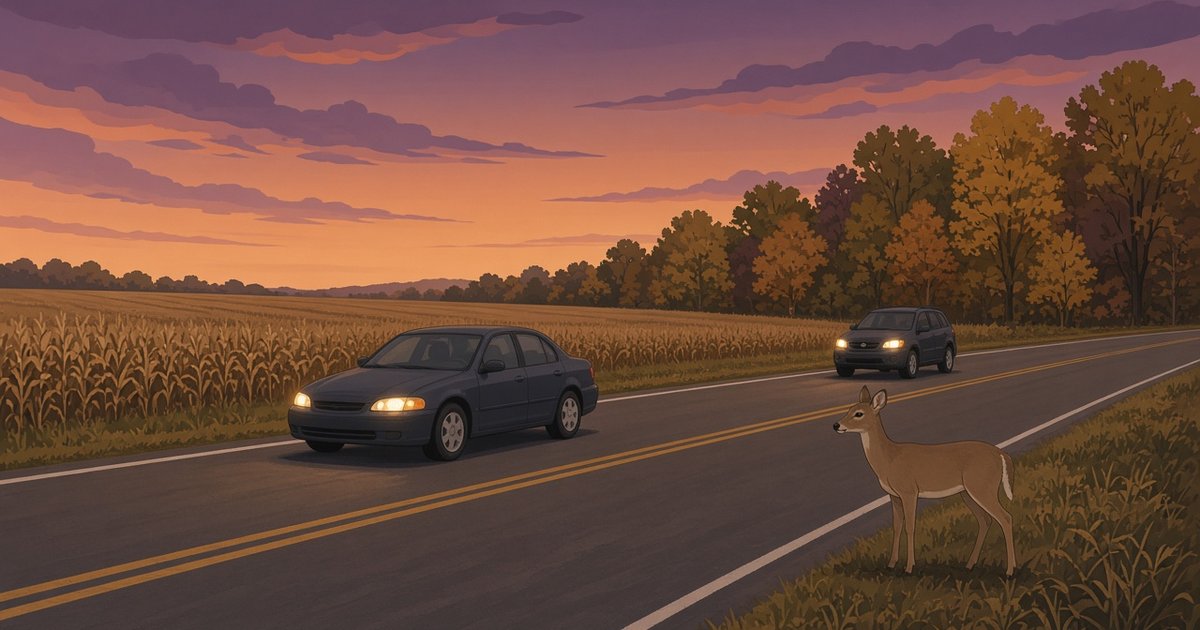
Clocks fell back an hour last Sunday, Nov. 1. For many Hoosiers, that means the drive home from work now happens in the dark, right as deer activity peaks. AAA’s message for this stretch of the year is short enough to remember when it counts: don’t veer for deer.
Deer Season Meets the Time Change
In an Oct. 30 news release, AAA pointed out that the time change puts many Indiana drivers on the road in darkness just as deer are most active.
The numbers show why that overlap matters:
- About 70% of animal-related crashes happen in the dark or around dawn and dusk, which AAA notes are prime commuting times for many drivers.
- Statewide, Indiana’s deer-vehicle collisions rose from 16,337 in 2024 to 17,835 in 2025, and nearly half happened between September and December, according to the release, which cites Indiana Department of Natural Resources data.
- From 2020 to 2024, Indiana tied with Florida for the 11th-highest death toll in animal-related crashes in the nation, according to the AAA Foundation for Traffic Safety.
- Nationwide, in November nearly one in three police-reported crashes in the Midwest involves hitting an animal, the AAA Foundation study found.
Southwest Indiana stands out. AAA’s analysis of DNR data counted 1,594 deer-vehicle collisions in the 12 counties of the Evansville area in 2025, up nearly 15% from 2024.
Our Indiana Driver Safety Program is a 4-hour, 100% online course from an approved Indiana BMV provider, and a good way to refresh the habits that help you react well on the road.
Why Swerving Is the Bigger Danger
It feels natural to jerk the wheel when a deer appears. But new AAA Foundation for Traffic Safety research suggests that instinct is often what gets people hurt.
The study looked at federal crash data from 2020 to 2024. When people in cars and trucks died in animal-related crashes, hitting the animal was the most harmful event in only 19% of those deaths. Hitting a tree or other object (33%) and rolling over (28%) were both more common, and hitting another vehicle (17%) was nearly as common.
Researchers say sudden moves to avoid a deer are often riskier than hitting it.
“Every instinct tells you to swerve, but following that instinct is often what gets people hurt,” AAA spokesperson Carly McKinnis said. “Brake firmly, stay in your lane and keep both hands on the wheel.”
What to Do When a Deer Appears
AAA’s guidance comes down to a few steps:
- Brake firmly. Slow down as much as you safely can.
- Stay in your lane. Keep both hands firmly on the wheel. Swerving can confuse the deer and can put you in the path of oncoming traffic or into a tree or ditch.
- Don’t swerve. As AAA puts it, a tree, a ditch or an oncoming vehicle can do far more damage to the people inside than a deer.
- If a crash is unavoidable, ease off the brake. AAA explains that hard braking pulls the front end down, which can send an animal up over the hood toward the windshield. Letting off the brake at the last moment makes it more likely the animal is pushed to the side or over the vehicle.
Habits That Help You Avoid the Encounter
- Be extra alert at dawn and dusk, especially on rural roads.
- Watch for deer crossing signs. The yellow diamond signs mark areas with high deer activity.
- Use high beams when there’s no oncoming traffic. Light reflecting off a deer’s eyes can reveal it sooner.
- Slow down when you see one deer. Deer rarely travel alone, so others may follow.
- Ditch distractions and buckle up. A seat belt is your best defense in any crash.
- Get some extra rest. AAA notes that your body takes a few days to adjust after the time change, and a tired driver is slower to spot a deer.
If You Hit a Deer
AAA recommends that you call the police, turn on your hazard lights, move to a safe spot out of the roadway if you can, and wait for help. Don’t approach the animal, since a frightened or injured deer can hurt you. Then contact your insurance company to report any damage.
For more seasonal tips, see our post on deer season driving. It’s written for New York, but the advice works on any rural road.
About the Indiana Driver Safety Program
Our course is from an approved Indiana BMV provider. It’s a 4-hour course, as required by the BMV, and you can pause anytime and pick up where you left off. Finishing earns a 4-point credit on your Indiana driving record, which you can use once every three years, and completion is reported to the BMV automatically within 24 hours. The course doesn’t remove a ticket or conviction from your record. Learn more in our guide to the 4-point credit.
The Bottom Line
For the next several weeks, your commute and peak deer activity overlap. Watch the roadsides, slow down when you see one deer, and if one steps out, brake firmly and stay in your lane.
Want a 4-point credit on your Indiana record? Start the Indiana Driver Safety Program.


