


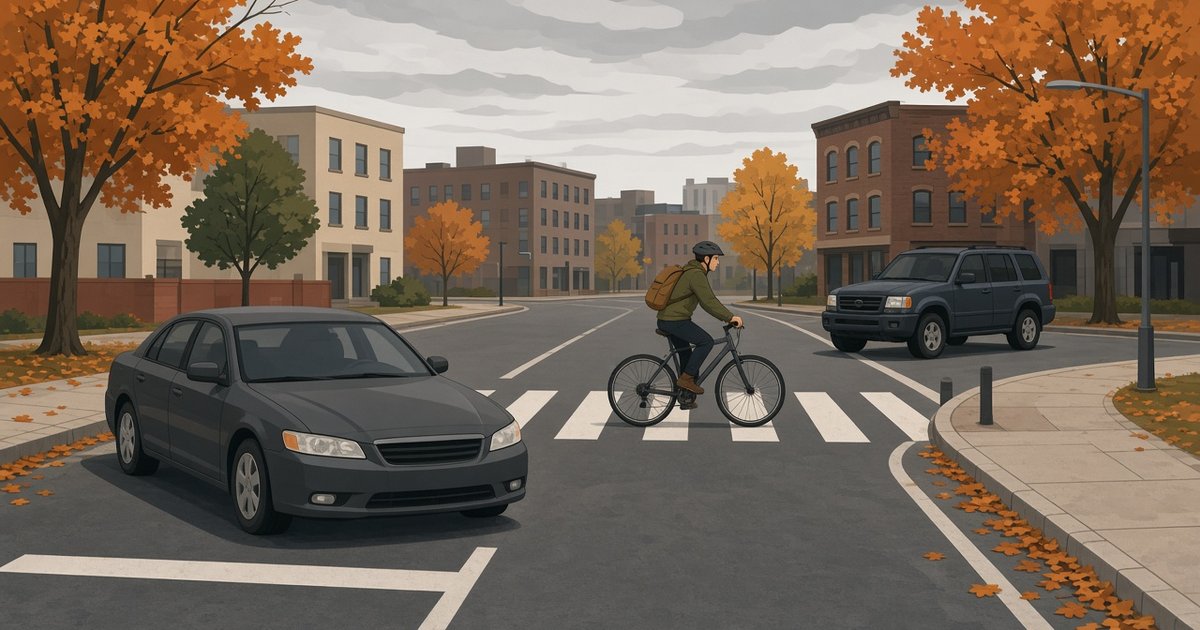
A right turn on red is one of the most routine moves in city driving. Most of us make several a week without thinking much about it. But a crash in Salem on Halloween afternoon shows how quickly that routine move can go wrong when someone on a bicycle is close by.
What Happened
KPTV reported that a 56-year-old Salem man riding a bicycle died after a crash with a car at State Street and 25th Street SE shortly after 3 p.m. on Saturday, Oct. 31.
According to a Salem Police news release, a 23-year-old driver heading north on 25th Street was stopped at a red light and began turning right onto eastbound State Street. The man was riding west on State Street when his bicycle came into contact with the car’s left front corner. He fell, was taken to a hospital with serious injuries, and later died.
The driver stayed at the scene and cooperated with investigators. Police say the investigation is ongoing, and it is the seventh fatal traffic crash Salem Police have investigated this year.
Our thoughts are with the man’s family and friends. Investigators will determine what happened at that intersection. What follows is general guidance for any driver turning right on red.
What Oregon Law Says About Turning on Red
Oregon allows a right turn on a steady red light into a two-way street, but only under conditions. Under ORS 811.360, a driver commits the offense of “improperly proceeding at a stop light” if they:
- Fail to stop at the light as required.
- Fail to exercise caution to avoid a crash.
- Disobey another sign or signal, or a police officer, that prohibits the turn.
- Fail to yield to traffic lawfully within the intersection, or approaching so close that it’s an immediate hazard.
The same statute says drivers turning on red must also follow Oregon’s rules on stopping for pedestrians. The offense is a Class B traffic violation. Oregon’s vehicle code also has separate offenses for failing to yield to a rider in a bicycle lane and failing to yield to a bicyclist on a sidewalk.
In other words, a red light doesn’t give a turning driver the right of way. It gives you a chance to turn only after you’ve stopped and made sure the way is clear.
Why Right-on-Red Turns Can Miss Bicyclists
When you’re waiting to turn right on red, your attention naturally goes to your left, where cross traffic is coming from. That’s where the cars are. But people on bicycles and on foot don’t always come from that direction. A rider may be crossing in front of you, coming from your right, riding in a bike lane beside you, or riding on a sidewalk or in a crosswalk.
Bicycles are also narrow and quiet, and they can be hidden behind a pole, a parked vehicle, or the frame of your own windshield. A driver who looks left, sees a gap in traffic, and starts rolling may have only a moment to react to someone approaching from another direction.
A Safer Right Turn on Red, Step by Step
- Stop completely behind the stop line. If there’s no line, stop before the crosswalk. Don’t roll into the crosswalk while you look for a gap.
- Check for signs. Some intersections post “no turn on red.” Obey them.
- Look left, ahead, right, then left again. Scan the crosswalks, the bike lane, the sidewalk, and the far side of the intersection.
- Look for people, not just cars. Ask yourself where a bicyclist or pedestrian could be coming from, including directions you wouldn’t expect traffic.
- Check your mirror and right shoulder for a rider coming up beside you in a bike lane.
- When in doubt, wait for green. Turning on red is allowed, not required. If your view is blocked or the intersection is busy, waiting one light cycle costs you very little.
- Turn slowly and keep scanning. Ease into the turn so you can stop if someone appears, and don’t let a honk from behind rush you.
Ticketed in Oregon? Ask Your Court About Traffic School
Some Oregon courts let eligible drivers take a traffic safety course in exchange for dismissal of a minor traffic violation. Each court sets its own rules. For example, the City of Springfield’s program says drivers may not qualify if the incident involved a crash. Our guide to Beaverton’s traffic school program shows how one Oregon court’s program works.
If your court offers the option, Defensive Drivers Institute’s Oregon Traffic Level 1 Course is court-approved for ticket dismissal and accepted by most Oregon courts, though your court may need you to confirm. It’s 100% online with 4 hours of content you can complete at your own pace. It covers Oregon traffic laws, defensive driving techniques, and hazard recognition, and your certificate is available as soon as you finish.
The Bottom Line
A right turn on red is a privilege that comes with a full stop and a full look. Check every direction, look for people as well as cars, and wait for green whenever you can’t see clearly.
Has your Oregon court offered traffic school? Start the Oregon Traffic Level 1 Course.


